


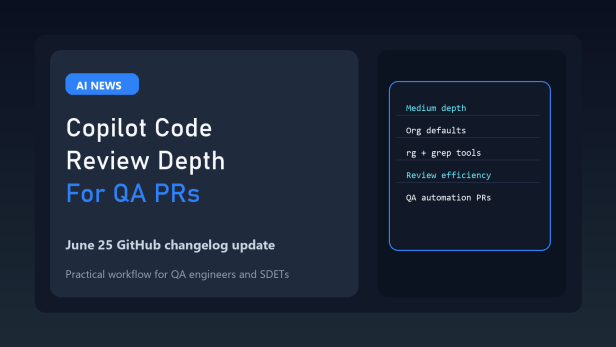
GitHub published a June 25, 2026 changelog update for Copilot code review analysis depth. The update is not a new model launch, but it is practical AI news for QA engineers who use Copilot to review test automation pull requests.
The key changes: Copilot code review now shows clearer Medium analysis depth attribution for teams in the public preview, organizations can set a default review level for repositories that have not configured one, and Copilot’s review path now uses the file exploration tools available in Copilot CLI and SDK.
What GitHub changed on June 25
- Medium review attribution: pull request overview comments can indicate when a review used Medium analysis depth.
- Organization defaults: organizations in the preview can set a default review level for repositories that have not configured their own level.
- Repository override: repositories can still override the organization default when a different review level fits that project.
- New file exploration path: GitHub says Copilot code review now uses
grep,rg,glob, andviewtools from Copilot CLI and SDK instead of earlier custom file exploration tools. - Efficiency claim: GitHub says these changes reduced Copilot code review costs by about 20% while maintaining the same review quality in its offline and online evaluation.
Why this matters for QA engineers
For QA engineers, the important part is consistency. Test automation reviews often need the reviewer to inspect related fixtures, page objects, API helpers, CI workflow files, and test data setup. A shallow review can miss hidden coupling, but a deeper AI review can also consume more budget and produce more comments than a small change needs.
- Automation PRs can use intentional defaults: teams can decide which repositories deserve Medium depth by default instead of leaving every repo to local habit.
- Review comments become easier to audit: Medium attribution helps reviewers understand which level produced the feedback.
- Cost and quality discussions get more concrete: GitHub’s reported efficiency improvement gives QA leads a reason to revisit where Copilot review is useful, not just whether it is enabled.
A practical QA rollout check
If your team uses Copilot code review on test automation repositories, treat this update as a configuration review, not just a product announcement.
- List repositories where automation changes often touch shared fixtures, framework utilities, or CI workflows.
- Use Medium analysis depth first on repositories where review misses have historically caused flaky tests or broken pipelines.
- Keep lighter settings for small documentation, selector-only, or low-risk test data changes.
- Track whether Copilot comments catch real issues such as weak assertions, missing cleanup, brittle waits, and over-broad mocks.
- Compare the value of the review with the cost and noise before making Medium depth the default everywhere.
What QA teams should watch next
The next useful signal will be whether teams can tie Copilot review depth to measurable test quality outcomes: fewer flaky-test regressions, fewer missed fixture changes, faster review of automation PRs, and fewer CI failures after merge.
For now, the best takeaway is straightforward: Copilot code review analysis depth should be treated like any other review policy. Set a default, document when to override it, and validate whether the feedback actually improves test reliability.